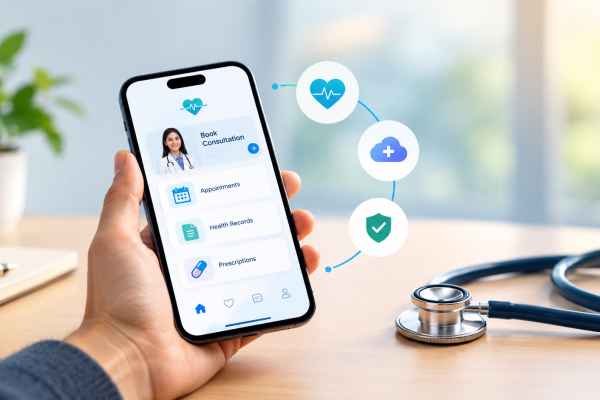


Travel app development in 2026 is no longer about building another search box. Travelers already have dozens of apps. What they don’t have is one that understands what they want, shows a price that stays true at checkout, and helps them when a flight is cancelled at midnight.
This guide walks through how we approach travel app development at Briskcovey choosing the right type of app, the features that matter, supplier integrations, compliance, architecture, and where AI genuinely earns its place.
Key Takeaways
- Pick one travel niche first. A focused tour, hotel or agency app beats a half-built Expedia clone.
- Inventory decides everything. Your GDS, NDC, bed bank and activity integrations shape cost, speed and margins more than any design choice.
- Never touch raw card data. Use a PCI DSS compliant payment gateway with tokenization from day one.
- Use AI to plan, not to invent prices. AI itinerary planning and chat booking work best when every price and seat is checked live before it’s shown.
- Plan realistic timelines. A focused travel MVP typically takes 3–4 months, a full booking platform with multiple suppliers takes 6–9 months.
Why Most Travel Apps Fail
Most travel apps don’t fail because of design. They fail at three quieter moments:
- The price changes at checkout. Cached fares and room rates go stale, the traveler sees a higher price on the payment page, and leaves. Few things destroy trust faster.
- The inventory is thin. An app with a beautiful interface but limited hotels, flights or tours gives travelers no reason to come back.
- Nobody helps when plans break. Delays, cancellations and refunds are where loyalty is won or lost, and most apps send travelers to an email inbox.
Good travel app development starts by solving these three problems, then adds features on top.
Step 1: Choose the Right Type of Travel App
In travel app development, The type of app you build decides your suppliers, your revenue model and how complex the build will be.
| Type of travel app | Typical users | Main inventory source | Build complexity |
| Online travel agency (OTA) for flights and hotels | Travelers | GDS, NDC airline APIs, bed banks | High |
| Hotel booking app | Travelers, hotel chains | Channel managers, property management systems | Medium |
| Tours and activities app | Travelers, tour operators | Own inventory or activity APIs | Medium |
| Tour operator software | Tour companies and their staff | Own packages, supplier contracts | Medium |
| Travel agency CRM and B2B portal | Travel agents | GDS, wholesaler APIs | Medium to high |
| Corporate travel app | Employees, finance and travel managers | GDS, NDC, policy rules | High |
| AI trip planner | Travelers | Content data plus booking APIs | Medium |
A practical rule if you are a new brand, start where you control the inventory, such as your own tours or a curated set of hotels. Competing head-on with large OTAs on flight prices needs scale, supplier contracts and cash flow that most startups don’t have yet.
Must-Have Travel App Features in 2026
A smart travel app development plan launches with the features your travelers and staff need on day one.
| Feature area | For travelers | For agents and operators | For admins |
| Search and discovery | Smart search with filters, flexible dates, maps | Fast multi-supplier search | Supplier and content management |
| Booking | Live availability, clear total price, instant confirmation | Holds, quotes and itinerary building | Booking rules, markups and commissions |
| Payments | Cards, wallets, local methods, multi-currency | Deposits and payment links | Refunds, reconciliation, payout reports |
| Trip management | E-tickets, vouchers, itinerary in one place, offline access | Changes and cancellations | Policy and cancellation rules |
| Communication | Push alerts, WhatsApp and email updates, in-app chat | Customer history and notes | Message templates |
| AI assistance | AI trip planner, conversational search | AI-drafted itineraries and replies | AI usage and quality review |
| Trust and support | Reviews, 24/7 help, disruption alerts | Escalation tools | Service-level dashboards |
| Localization | Languages including right-to-left Arabic, local currencies | Multi-language quotes | Content translation workflow |
Step 2: Plan Inventory and Supplier Integrations (GDS, NDC, Bed Banks)
In travel app development, integrations are the product. They decide what you can sell, how fast search feels and how much margin you keep.
| Integration | What it gives you | Examples | Things to plan for |
| GDS (Global Distribution System) | Flights, plus hotels and car rentals, from one connection | Amadeus, Sabre, Travelport | Certification, transaction fees, ticketing rules |
| Airline NDC APIs | Richer airline offers, bundles and ancillaries | IATA NDC-enabled airlines | Different API per airline, servicing flows |
| Bed banks and hotel wholesalers | Wide hotel inventory at net rates | Hotelbeds, WebBeds | Rate parity, cancellation policies |
| Channel managers | Direct hotel inventory and rates | Property and channel management systems | Mapping room types correctly |
| Activities and tours | Tours, tickets and experiences | Activity marketplaces and your own inventory | Time slots, capacity, vouchers |
| Payments and fraud | Secure checkout | PCI DSS–compliant gateways | Chargebacks, 3-D Secure, local methods |
Most teams start in sandbox with a self-service API such as Amadeus for Developers, then move to production contracts. Airlines are steadily shifting offers to IATA’s NDC standard, so flight apps built today should be ready for both GDS and NDC content.
Three rules we follow:
- Sign supplier agreements early. Production access and certification often take longer than the build itself.
- Cache smartly, confirm live. Cache search results for speed, but always re-check price and availability before payment.
- Map content once. Normalize hotels, room types and locations from every supplier into one clean data model.
Step 3: Get Payments, Compliance and Security Right
Travel app development involves passports, payment cards and personal itineraries, so security and compliance have to be designed in, not added later.
| Area | What to plan for | What it means for the build |
| Card payments | PCI DSS | Use a compliant gateway with tokenization so your servers never store raw card numbers |
| Personal data | GDPR (EU and UK), CCPA (California), UAE PDPL, India’s DPDP Act | Consent, data minimization, deletion requests, regional hosting where required |
| Travel bundles | Package travel rules such as the EU Package Travel Directive | Clear terms, insolvency protection and refund handling when you sell flight and hotel packages |
| Refunds and disruptions | Airline and consumer refund rules in each market | Automated refund flows and clear cancellation policies at checkout |
| Local licensing | Travel agency licensing in markets like Dubai | Confirm whether your business model needs a local travel license before launch |
| Accessibility | WCAG 2.2 AA | Readable fonts, screen reader support, accessible booking forms |
The technical baseline stays the same in every market: encryption in transit and at rest, role-based access for staff, audit logs, MFA for admin accounts, and fraud checks such as 3-D Secure on card payments.
This section is a planning guide, not legal advice. Confirm your obligations with qualified counsel in each market.
Step 4: Design a Reliable Booking Engine and Tech Stack
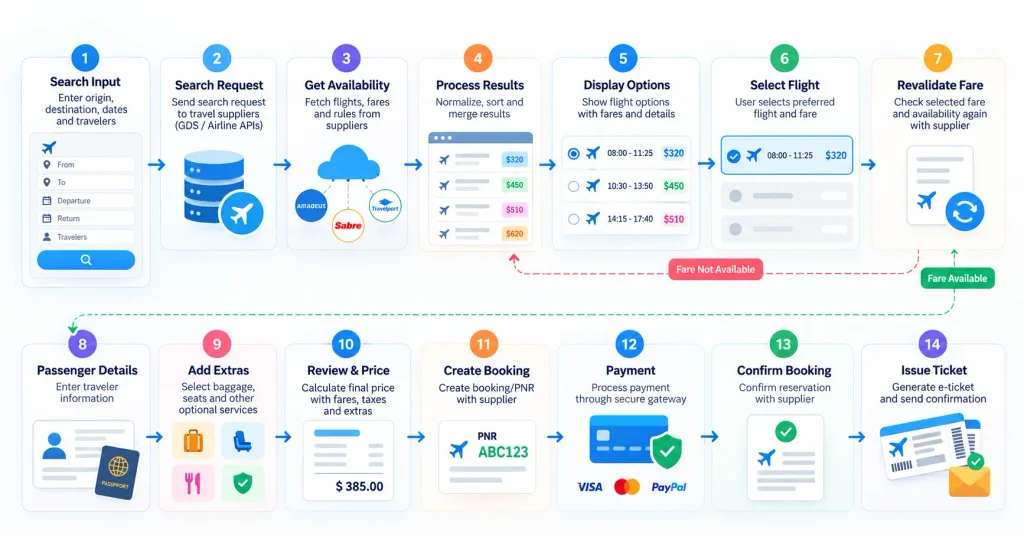
The booking engine is the heart of every travel app development. A good one follows the same six steps for every booking:
- Search: query suppliers in parallel and show fast, cached results.
- Availability check: confirm the selected option is still available.
- Price verification: re-price live, so the total shown is the total charged.
- Hold: reserve the seat or room while the traveler pays, where suppliers allow it.
- Book and pay: take payment and confirm with the supplier in one safe transaction.
- Ticket and confirm: issue e-tickets or vouchers and send confirmations instantly.
| Layer | Our default choice | Why |
| Mobile app | React Native or Flutter | One codebase for iOS and Android |
| Web app and admin | React + TypeScript | Fast search pages and dense admin screens |
| Backend API | Python (FastAPI) or Node.js | Handles parallel supplier calls, Python keeps AI work in the same stack |
| Database | PostgreSQL and Redis cache | Reliable bookings plus fast cached search |
| Search | Elasticsearch or OpenSearch | Quick filtering across thousands of hotels and tours |
| Messaging | Queues for bookings and notifications | Retries and confirmations even when suppliers are slow |
| Hosting | AWS, Azure or GCP | Scales for seasonal peaks |
Three design rules we hold to:
- Make every booking request idempotent, so a retry after a timeout never creates a double booking or a double charge.
- Store prices with currency and timestamp, and support multi-currency checkout from the start.
- Plan for supplier failures. Set timeouts, show partial results, and log every supplier call for support and disputes.
Step 5: Add AI to Your Travel App Where It Pays Off
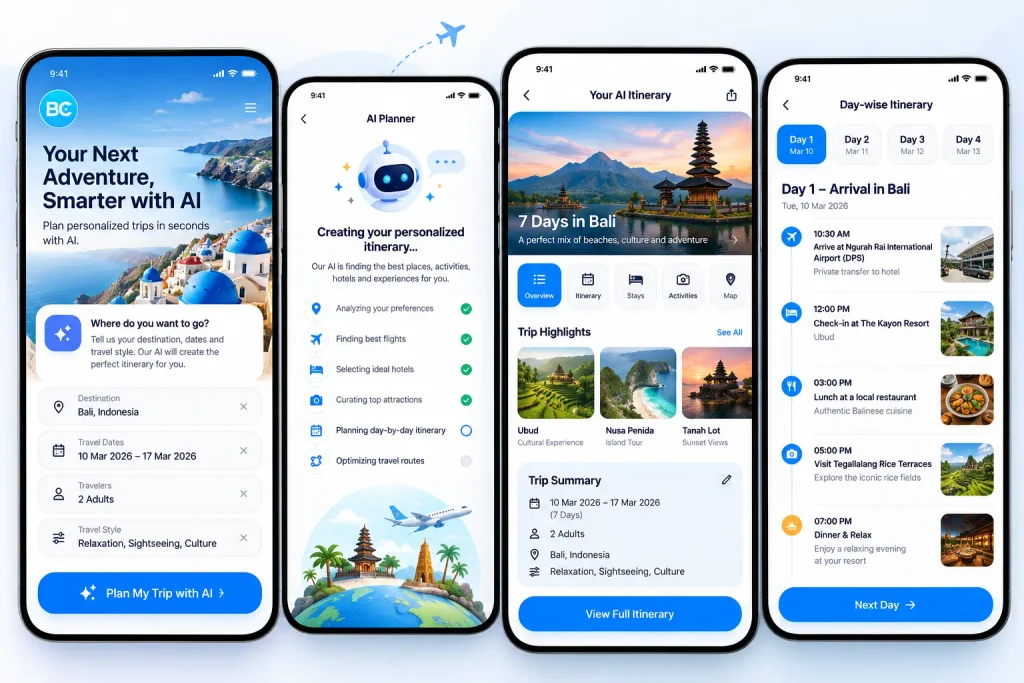
In travel app development today, AI is now the biggest difference between a travel app people use once and one they open for every trip. The best AI features remove effort for travelers and staff.
High-value AI features for travel apps:
- AI trip planner. The traveler describes the trip in plain words (“5 days in Dubai with kids, mid-range budget”) and gets a day-by-day itinerary with bookable hotels and activities.
- Conversational search and booking. Chat-based search in the app or on WhatsApp, in the traveler’s own language.
- WhatsApp booking assistants for agencies. AI answers enquiries, qualifies leads, sends quotes and hands complex cases to a human agent.
- Disruption handling. When a flight is delayed or cancelled, AI suggests rebooking options and drafts messages before the traveler has to ask.
- Dynamic pricing and personalization. Suggest prices and offers based on demand, season and traveler history.
- Review and content summaries. Turn hundreds of reviews into a short, honest summary for each hotel or tour.
Guardrails we build into every AI travel feature:
- AI never invents prices, seats or rooms. Every option it suggests is checked live through supplier APIs before it is shown or booked.
- Bookings and payments always need a clear traveler confirmation.
- Personal data is minimized in AI prompts, and every AI conversation is logged.
- A human agent can take over any conversation at any time.
We use the same approach in our AI automation services and in the WhatsApp lead automation we build for real estate brokers. As an Anthropic Claude Partner, we use Claude for planning and conversation features, because travel content needs careful, accurate language more than raw speed.
Step 6: Follow a Travel App Development Process Built Around Real Bookings
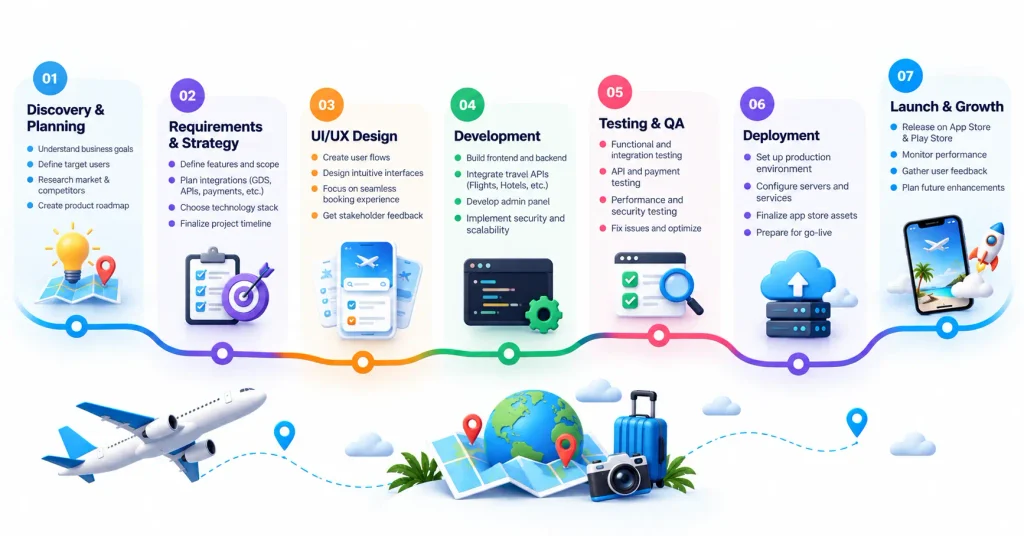
Travel app development has one extra risk, supplier approvals. Plan the process around them.
- Discovery (2–3 weeks). Define the travel niche, target markets, revenue model and suppliers. Start supplier and payment-gateway applications now.
- UX design and prototype (3–4 weeks). Clickable prototype tested with real travelers and, for B2B apps, real agents.
- MVP build (8–14 weeks). Booking engine, first supplier integrations, payments, admin panel and notifications, in two-week sprints.
- Supplier certification and testing (3–6 weeks). Test bookings in sandbox, complete supplier certification, load-test for peak season, and run a security review.
- Soft launch (4 weeks). Launch to a small audience or one market, monitor every booking, and fix issues fast.
- Scale. Add suppliers, markets, languages and AI features based on real data.
In travel app development, a focused travel MVP typically takes 3–4 months. A full booking platform with several suppliers, AI features and multiple markets takes 6–9 months.
Travel App Launch Checklist
Use this checklist before any travel app development project goes live.
- Supplier production access and certification completed
- Live price and availability re-check before every payment
- PCI DSS–compliant payment gateway with tokenization and 3-D Secure
- Privacy policy, consent screens and cookie settings live for each market
- Cancellation, refund and package terms shown clearly before checkout
- Booking confirmation emails, WhatsApp or SMS messages and push alerts tested
- Duplicate-booking and double-charge protection tested
- Load test passed for peak season traffic
- 24/7 support path and disruption process defined
- App store listings, screenshots and privacy labels ready
- Analytics set up: search-to-booking conversion, drop-off points, repeat bookings
Frequently Asked Questions
A focused travel MVP usually takes 3–4 months. A full booking platform with several suppliers, payments, AI features and multiple markets takes 6–9 months, mostly because supplier certification adds time.
Live search and availability, a clear total price, secure payments, instant confirmations, trip management with e-tickets, real-time alerts, reviews, 24/7 support and multi-language, multi-currency checkout. AI trip planning is fast becoming standard.
A GDS (Global Distribution System) such as Amadeus, Sabre or Travelport connects your app to airline and travel inventory through one integration. You need one if you sell flights at scale. Hotel, tour and activity apps can often start without a GDS.
NDC (New Distribution Capability) is an IATA standard that lets airlines sell richer offers, bundles and extras directly through APIs. New flight booking apps should support both GDS and NDC content.
By using a PCI DSS compliant payment gateway with tokenization, so the app never stores raw card numbers, plus 3-D Secure checks, fraud screening and encryption.
For AI trip planning, conversational search, WhatsApp booking assistants, disruption handling, personalization and review summaries. Every price and availability the AI shows should be verified live with suppliers.
For most travel apps, cross-platform (React Native or Flutter) is faster and keeps one codebase for iOS and Android. Native makes sense only for heavy offline maps or device-specific features.
You can build the same type of booking experience, but competing on inventory and price takes major supplier deals and scale. Most new brands succeed by starting with a focused niche, region or traveler type.
React Native or Flutter for mobile, React for web, Python (FastAPI) or Node.js for the backend, PostgreSQL with Redis caching, a search engine like Elasticsearch, and cloud hosting that scales for peak seasons.
BriskCovey is an AI first software studio and Anthropic Claude Partner. We build booking platforms, supplier integrations and AI assistants, including WhatsApp automation, for clients in the US, UK, UAE and Australia.
Build Your Travel App With Briskcovey
Briskcovey is an AI-first software studio in Jaipur, India, and an Anthropic Claude Partner. We offer end-to-end travel app development, travel booking apps, tour operator software, travel agency tools and AI travel assistants for clients in the US, UK, UAE and Australia. We also build healthtech platforms and AI products using the same AI-first approach.
Whether you need a focused travel MVP, an AI trip planner for an existing platform, or a full booking engine with GDS and NDC integrations, we start the same way one clear traveler journey, mapped properly.
Book a free 30-minute travel app discovery call