

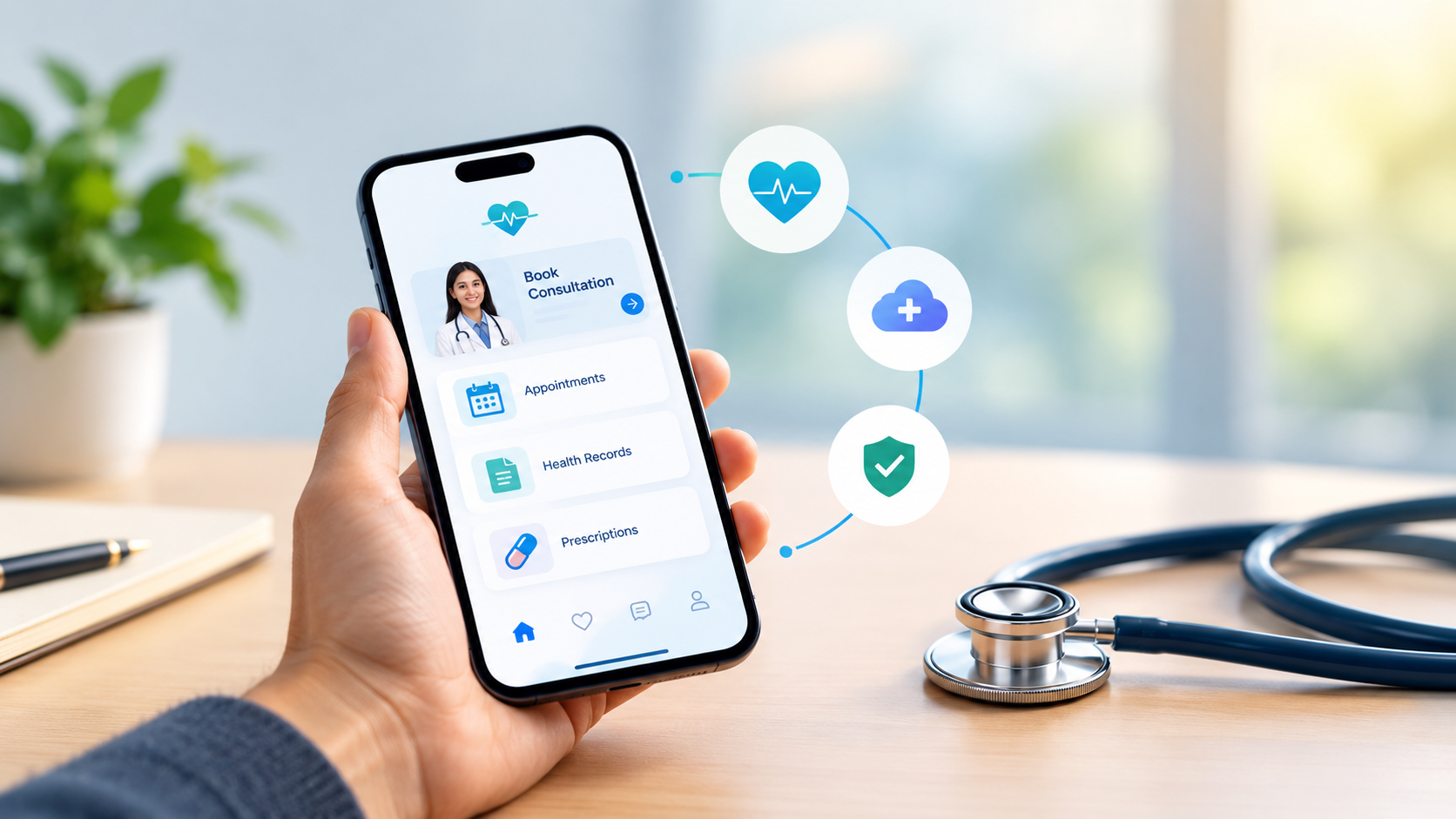
Why Most HealthTech Apps Fail (And It Is Rarely the Code)
Most healthtech app development projects do not fail because the software breaks. The fail because a doctor opens them once, finds they add three clicks to a twelve-minute consult, and goes back to paper.
Most guides give you a long checklist covering features, compliance, technology, and testing. All of these things matter. But from our experience at BriskCovey, the healthcare projects that work best usually start with one specific clinical problem that needs to be solved. The technology and features should then be built around solving that problem effectively.
This playbook is how we approach healthcare app development in 2026, when AI is no longer a bonus feature but something clinicians and patients now expect. It covers the decisions in the order you will actually face them.
Key Takeaways
- Start with one workflow. The best healthtech apps solve one painful clinical moment before adding features.
- Compliance is architecture. HIPAA, GDPR, DPDP, ABDM and UAE health data rules shape your hosting, logging and access design from day one.
- Build on HL7 FHIR. Interoperability with EHRs, labs and national health networks is now a buying requirement.
- Use AI to remove paperwork. AI patient intake, clinical notes and reminders deliver value fast with low regulatory risk.
- Plan realistic timelines. A focused healthtech MVP takes 2–3 months, a full clinic platform takes 4–6 months.
Start From One Clinical Workflow, Not a Feature List
Before wireframes, map one real workflow end to end. Sit in a clinic for a day if you can. Watch the front desk, the consult room and the billing counter.
Ask three questions for each step:
- Who touches it? Receptionist, nurse, doctor, patient, lab, insurer.
- Where does time leak? Re-typing patient details, chasing reports, phone calls to confirm appointments.
- What happens when it goes wrong? A missed allergy, a lost referral, a double booking.
Pick the one step where time leak and risk overlap most. That is your MVP. A clinic that saves 20 minutes a day on intake will forgive a missing analytics dashboard. A clinic that loses data once will never come back.
Write this down as a one-page “clinical job story”: When a returning patient arrives, the doctor needs their last visit, current medicines and allergies on one screen, so the consult starts with care, not questions. Every feature request later gets tested against that sentence.
Choose the Right Type of HealthTech App
The category you choose sets your regulatory burden, your buyer and your sales cycle. Choose it deliberately.
| Category | Typical buyer | Regulatory weight | Time to first revenue |
| Clinic / practice management (scheduling, billing, EMR-lite) | Clinic owner | Medium (health data privacy) | Short |
| Telehealth and econsultation | Clinics, hospitals, direct-to-patient | Medium to high (prescribing rules vary by country) | Medium |
| Patient engagement (reminders, intake, followups) | Clinics, pharma, insurers | Low to medium | Short |
| Remote patient monitoring (wearables, vitals) | Hospitals, insurers | High (often device rules) | Long |
| Full EHR / hospital information system | Hospitals, health networks | High | Long |
| Clinical decision support / diagnostic AI | Hospitals, specialists | Highest (may be regulated as a medical device) | Longest |
A practical rule if your software influences a diagnosis or treatment decision on its own, assume it may be treated as Software as a Medical Device (SaMD) and get regulatory advice early. If it organizes, reminds, records or summarizes for a clinician who decides, your path is usually lighter.
Must Have Features of a HealthTech App in 2026
The right feature set depends on who uses the app. Here is the core most clinic and patient apps need at launch.
| Feature | For patients | For clinicians and staff | Admin / clinic owner |
| Accounts and security | Secure sign-up, OTP or biometric login | Role-based access, MFA | User and role management |
| Appointments | Online booking, reminders on WhatsApp / SMS | Calendar, queue and waitlist view | Slot rules across doctors and branches |
| Records | Personal health record, reports download | EMR-lite: history, prescriptions, allergies | Data export and retention controls |
| Communication | Chat, video consults | Secure messaging, referrals | Broadcast notices |
| AI assistance | Multilingual AI intake form | AI-drafted notes and visit summaries | AI usage logs and review queue |
| Billing and payments | Online payment, invoices | Billing and insurance codes | Revenue and collection reports |
| Analytics | Health trends and goals | Patient follow-up lists | Footfall, no-shows, revenue dashboards |
Launch with the rows that serve your clinical job story. Add the rest once real users ask for them.
Build HIPAA, GDPR and ABDM Compliance In From Day One
Retrofitting compliance costs far more than designing for it. Decide your launch markets first, because the rules differ sharply. For US launches, start with the official HHS HIPAA guidance.
| Market | Key rules to plan for | What it means for the build |
| United States | HIPAA (Privacy and Security Rules), HITECH, FDA if the app is a medical device | Business Associate Agreements with every vendor touching PHI, including your cloud and AI provider, audit logs, breach notification process |
| European Union | GDPR, EU MDR for medical-device software | Lawful basis and explicit consent for health data, data minimization, right to erasure, DPIA before launch |
| United Kingdom | UK GDPR, NHS DSPT and DCB0129 clinical safety for NHS suppliers | A named Clinical Safety Officer and hazard log if selling into the NHS |
| UAE | Federal health data law (ICT in health fields) plus DHA (Dubai) and DoH / ADHICS (Abu Dhabi) standards | Expect health data to stay incountry by default, plan for UAEregion hosting |
| Australia | PrivacyAct 1988, My Health Records Act, TGA for software medical devices | Strong consent and disclosure rules, TGA classification check for any diagnostic feature |
| India | DPDP Act 2023, ABDM standards for digital health | Consent-based data sharing, ABHA ID linking and ABDM certification if you join the ecosystem |
Whatever the market, the technical baseline is the same:
- Encryption in transit (TLS 1.2+) and at rest (AES-256), with managed keys
- Role-based access so a receptionist never sees clinical notes they do not need
- Immutable audit logs of who viewed or changed every record
- Automatic session timeouts and MFA for staff accounts
- A tested backup, restore and breach-response plan
This section is a planning guide, not legal advice. Confirm your obligations with qualified counsel in each market.
Plan Interoperability EarlyWith HL7 FHIR and SMART on FHIR
A health app that cannot exchange data becomes another silo clinicians have to re-type into. Build on open standards such as HL7 FHIR from the start, and if you serve India, follow the ABDM framework.
- HL7 FHIR (R4) is the common language for patients, encounters, observations, medications and appointments. Model your core data as FHIR resources, even if you store it differently internally.
- SMART on FHIR lets your app launch inside an existing EHR such as Epic or Cerner with single sign-on and the patient already in context. This is often the fastest way into hospitals.
- ABDM (India) connects your app to ABHA health IDs and consent-based record sharing across providers. If you serve Indian clinics, it is fast becoming a buying criterion.
- Lab and device feeds still often arrive as HL7 v2 messages or vendorAPIs. Budget for an integration layer that translates them into your FHIR model.
Treat integrations as a product surface, not a one-off task. Version your APIs, log every exchange and build retry handling, because hospital systems go offline more than you expect.
Choose a Scalable Tech Stack and Multi-Tenant Architecture
If you plan to sell to many clinics, design for multi-tenancy from the first commit. Separating tenants later is one of the most expensive rewrites in SaaS.
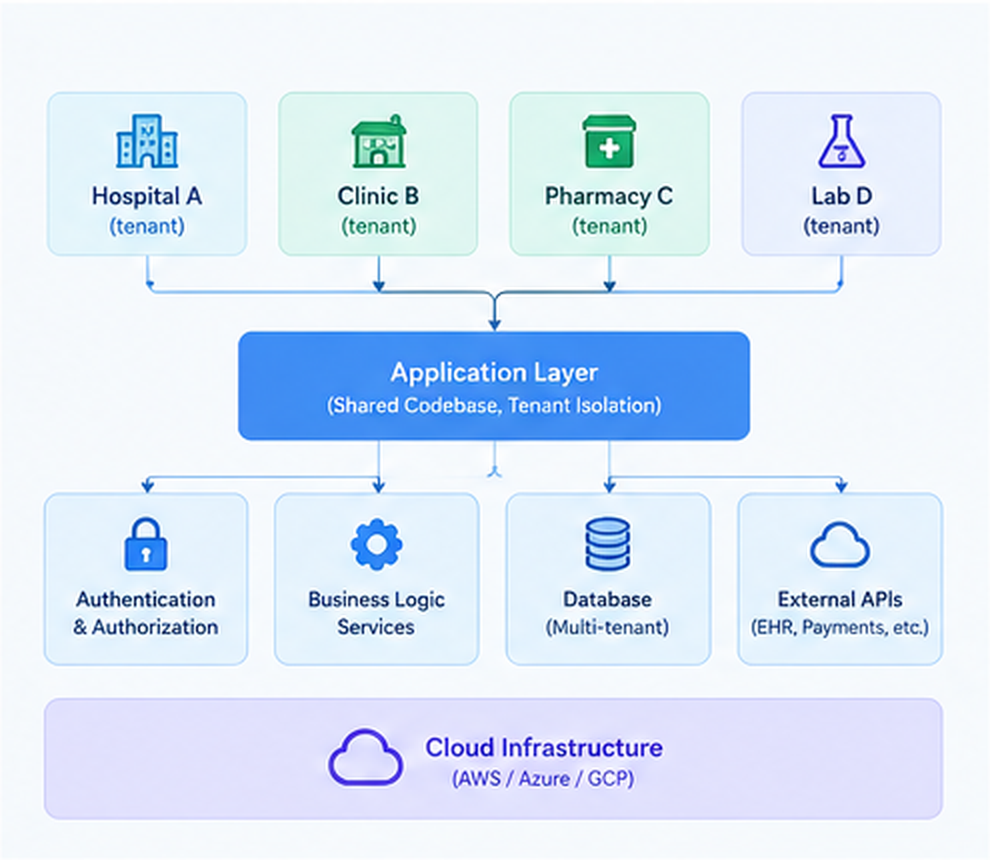
| Layer | Our default choice | Why |
| Web app (staff) | React + TypeScript | Fast, accessible UIs for dense clinical screens |
| Mobile app (patients) | React Native or Flutter | One codebase for iOS and Android |
| Backend API | Python (FastAPI) or Node.js | Python keeps AI and data work in the same stack |
| Database | PostgreSQL with row-level security per tenant | Hard isolation between clinics at the data layer |
| Interoperability | FHIR server or FHIR-mapped API layer | Clean exchange with EHRs, labs and national systems |
| AI layer | LLM gateway with PHI redaction, prompt logging and human review | Controlled, auditable use of models |
| Hosting | AWS, Azure or GCP in the patient’s region | Data residency and signed BAAs |
| Observability | Centralized logs, uptime alerts, audit trail store | Fast incident response and compliance evidence |
Three design rules we hold to:
- Tenant ID on every row and every query. Enforce it in the database, not only in application code.
- Separate PHI from everything else. Analytics, logs and AI prompts get de-identified data unless there is a clear clinical need.
- Offline-tolerant front ends. Clinics in many markets work through patchy internet. Queue writes locally and sync safely.
Add AI to Your Healthcare AppWhere It Removes Work
In 2026, AI is the difference between a health app clinicians tolerate and one they ask for. But the safest wins are the ones that take paperwork off people, not judgment.
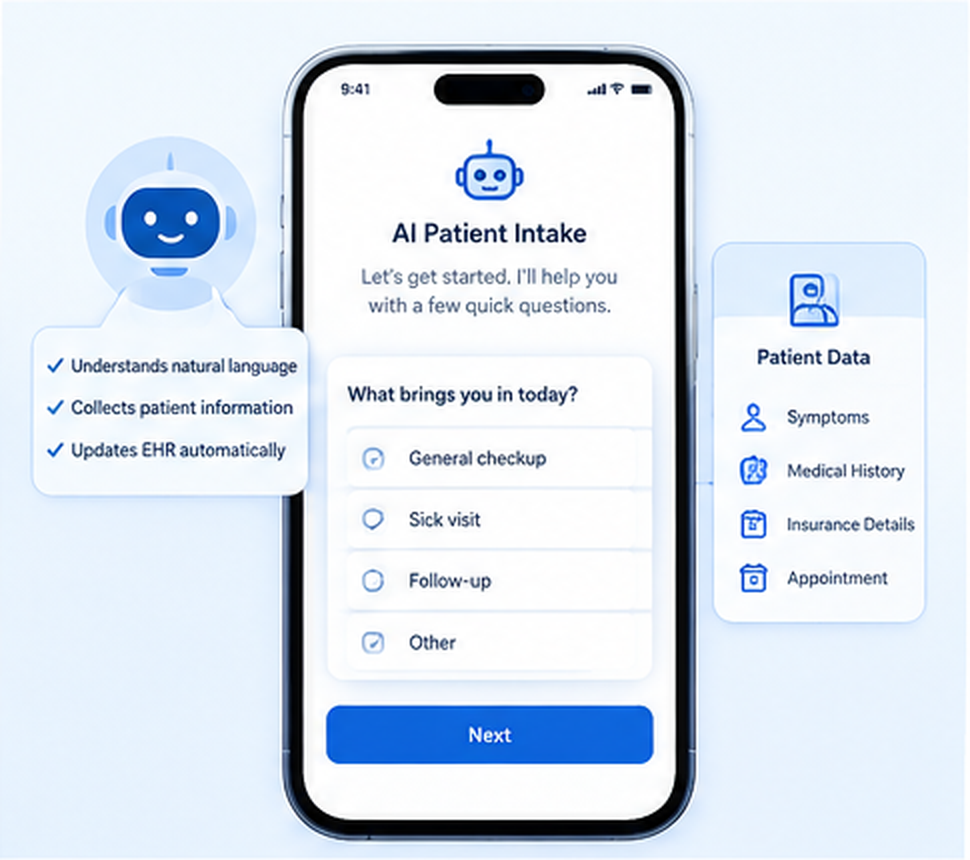
High value, lower risk (start here):
- AI patient intake. A conversational form in the patient’s own language collects symptoms, history and medicines before the visit, then hands the doctor a structured summary.
- Ambient or dictated clinical notes. Turn a consult conversation into a draft SOAP note the doctor edits and signs.
- Smart scheduling and reminders. Predict no-shows and send reminders on WhatsApp or SMS at the right time.
- Document understanding. Extract values from uploaded lab reports and referral letters into the record.
- Billing and coding support. Suggest codes and flag missing information before claims go out.
Higher risk (needs clinical validation and regulatory review): triage recommendations, diagnosis suggestions, dosing advice, image interpretation.
Guardrails we build into everyAI feature:
- A human clinician reviews and approves anything that enters the medical record.
- The AI provider signs a BAA or equivalent data agreement, with zero data retention where available.
- Personal identifiers are redacted from prompts unless the task truly needs them.
- Every prompt, response and edit is logged for audit.
- Output is evaluated against a test set of real (de-identified) cases before release, and re-checked after every model update.
As an Anthropic Claude Partner, we use Claude in our AI automation services for intake, summarization and documentation work, because careful, well-reasoned language matters more in healthcare than raw speed.
Follow a Healthcare App Development Process Built Around Pilots
Agile works in healthcare, with a few additions, a clinical voice in every sprint, and security and safety checks that are never skipped to hit a date.
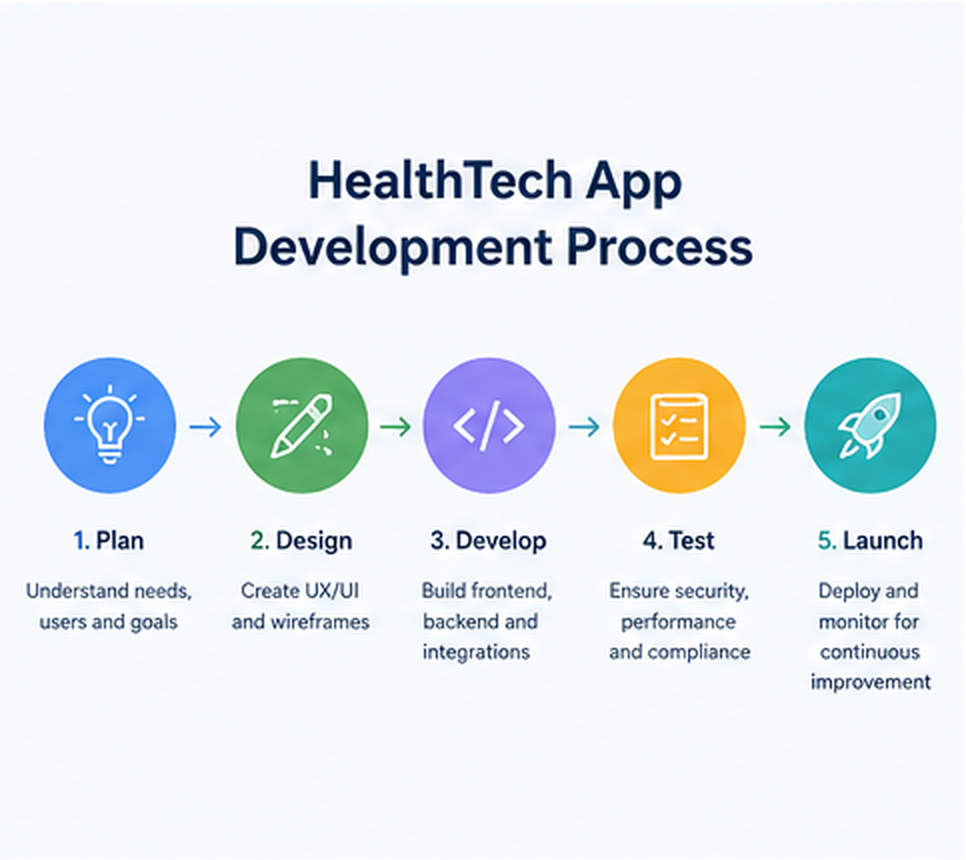
- Discovery (2–3 weeks). Workflow mapping, clinical job story, market and regulatory scoping, data map of every field you will store.
- Design and validation (2–4 weeks). Clickable prototype tested with at least five real clinicians and five patients. Accessibility checked against WCAG 2.2 AA.
- MVP build (8–16 weeks). Two-week sprints, a practicing clinician as advisor reviewing every demo, compliance controls built alongside features.
- Testing and hardening (3–4 weeks). Functional and regression tests, load testing, third-party penetration test, AI evaluation against de-identified cases, data-migration dry runs.
- Pilot (4–8 weeks). Two or three friendly clinics, real patients, daily feedback loop. Measure time saved per visit and staff adoption, not just bugs.
- Launch and scale. Onboarding playbook, training videos, support SLAs, then roll out market by market.
The pilot is usually when you start finding the problems you did not expect. Maybe the printer does not work with your prescription format, the receptionist is using a shared login, or the internet keeps dropping around 11 am. These small issues can quickly affect the whole workflow, so it is better to identify them early and plan for them.
Case Study:What Building RazorClinic Taught Us
RazorClinic is BriskCovey’s own multi-tenant clinic management SaaS. Building our own product, not just client projects, changed how we approach every healthtech build.
- Multi-tenancy is a day-one decision. Each clinic’s data is isolated at the database layer, which made onboarding new clinics a configuration task instead of an engineering project.
- The front desk decides adoption. Doctors sign the contract, but receptionists use the system all day. We redesigned flows around their speed first.
- Local integrations beat generic features. For Indian clinics, ABDM-readyAI patient intake mattered more than a long list of modules.
- AI earns trust in small steps. We started with summaries the doctor can edit, not suggestions that replace their judgment.
- Messaging channels matter. Reminders on the channels patients already use do more for no-shows than any in-app notification.
HealthTech App Launch and Post Launch Checklist
- Penetration test passed and findings fixed.
- Privacy policy, consent screens and data-processing agreements live.
- BAAs or equivalent signed with every vendor that touches health data.
- Audit logging verified end to end.
- Backup restore tested, breach-response plan rehearsed.
- App store health-data declarations completed (Apple and Google both review these closely).
- Clinician and staff training material ready.
- Support SLA and escalation path defined.
- Adoption metrics tracked: daily active staff, time per visit, no-show rate, patient satisfaction.
- AI outputs monitored for quality drift after every model update.
- Quarterly compliance review scheduled.
Frequently Asked Questions
A focused MVP usually takes 2–3 months. A multi-tenant clinic platform takes 4–6 months, and products with deep EHR integrations or regulated AI features take 6–12 months or more.
Only if you handle health data of US patients for US covered entities. Other markets have their own rules, such as GDPR in Europe, DPDP and ABDM in India and federal health data law in the UAE. Plan for each market you launch in.
FHIR is the modern standard for exchanging health data between systems. If you ever plan to connect with hospitals, labs or national health networks, designing around FHIR early saves major rework.
Yes, with safeguards, a data agreement with the AI provider, redaction of personal identifiers where possible, human. review of clinical output and full audit logging.
It may be if it diagnoses, treats or recommends treatment on its own. Apps that schedule, record, remind or summarize for a clinician usually are not. Get a regulatory opinion before building diagnostic features.
For most clinic and patient apps, crossplatform (React Native or Flutter) is faster and cheaper. Go native only when you need deep device or sensor access.
Most healthcare apps need secure login, appointment booking with reminders, patient records, secure messaging or video consults, billing, and role-based access. In 2026, AI patient intake and AI-drafted clinical notes are fast becoming standard.
ABDM (Ayushman Bharat Digital Mission) is India’s national digital health framework. Integrating it lets your app link patients’ ABHA health IDs and share records with consent across providers, which Indian hospitals and clinics increasingly expect.
A proven stack is React for web, React Native or Flutter for mobile, Python (FastAPI) or Node.js for the backend, PostgreSQL with row-level security, and a FHIR layer for interoperability, hosted in a compliant cloud region.
Encrypt data in transit and at rest, enforce role-based access and MFA, keep immutable audit logs, host in the patient’s region, sign data agreements with every vendor and run regular penetration tests.
Usually yes. AI intake, note drafting, document extraction and smart reminders can be added as a separate service connected through APIs, with human review built in.
BriskCovey is an AI-first software studio and Anthropic Claude Partner that builds and runs its own clinic SaaS, RazorClinic. We bring hands-on experience with multi-tenant architecture, ABDM, FHIR and safe AI in clinical workflows for clients in the US, UK, UAE, Australia and India.
Build Your HealthTech Product With BriskCovey
BriskCovey is an AI-first software studio in Jaipur, India, and an Anthropic Claude Partner. We design and build compliant healthtech platforms for clinics, startups and health networks across the US, UK, UAE, Australia and India, and we run our own clinic SaaS, RazorClinic.
Whether you need a focused MVP, an AI intake or documentation layer for an existing system, or a full multi-tenant platform, we start the same way: one clinical workflow, mapped properly
Book a free 30-minute healthtech discovery call