
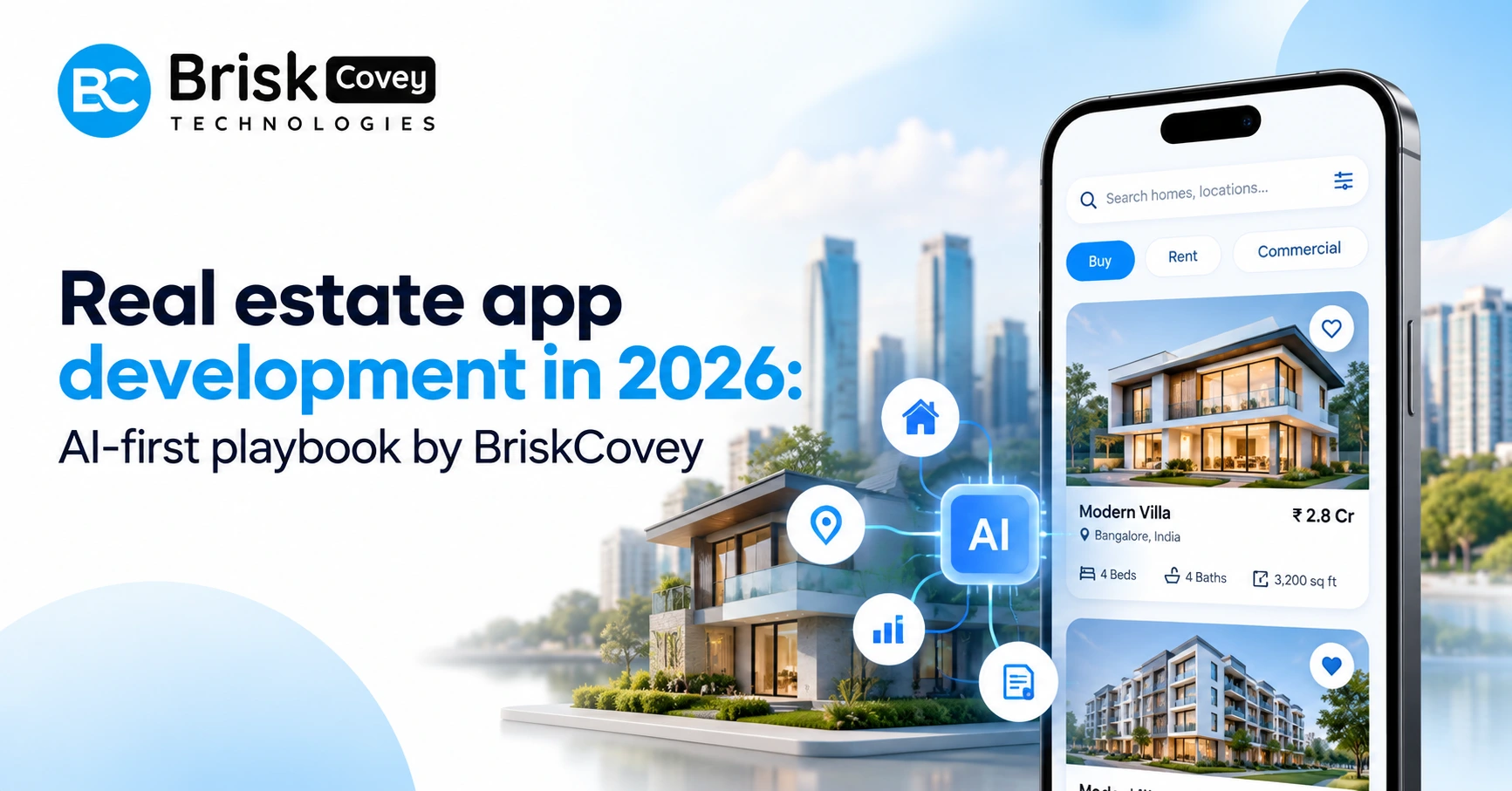
Real estate app development in 2026 is about speed. Buyers and renters message several agents at once, and the agency that replies first, with the right property, usually wins the deal. Yet many brokerages still copy leads from portals into spreadsheets and answer WhatsApp messages hours later.
This guide explains real estate app development step by step, the types of apps, must-have features, listing integrations, compliance, architecture, and where AI makes the biggest difference. It’s the same approach we use in our real estate app development work at Briskcovey.
Key Takeaways
- Speed-to-lead wins deals. The best real estate apps answer, qualify and route every lead within minutes, not hours.
- Listing data is the foundation. Portal, MLS and CRM integrations matter more than any screen design.
- Build for the market you serve. Dubai, US and Australian real estate each have different listing sources and advertising rules.
- Use AI to qualify and assist, not to mislead. AI lead agents work best when they answer only from verified listing data and hand over to a human agent.
- Plan realistic timelines. In real estate app development, a focused MVP typically takes 3-4 months, a full platform with portals, CRM and AI takes 5-8 months.
Why Most Real Estate Apps Fail
Most real estate apps don’t fail because of design. They fail in three places:
- Leads go cold. Enquiries arrive from portals, websites and social ads, and nobody replies for hours. By then the buyer has already booked a viewing elsewhere.
- Listings are out of date. Sold or rented properties stay online, prices are wrong, and buyers stop trusting the app.
- Agents don’t use it. If the app adds work instead of saving it, agents go back to WhatsApp and spreadsheets, and the data disappears with them.
Good real estate app development solves these three problems first. Everything else is a feature on top.
Step 1: Choose the Right Type of Real Estate App
In real estate app development, the type of app you build decides your users, your data sources and how complex the project becomes.
| Type of real estate app | Main users | Main data source | Build complexity |
| Property portal (buy, rent, sell) | Buyers, renters, sellers, agents | Agent and developer listings, feeds | High |
| Brokerage app and CRM | Brokers, agents, managers | Portal leads, own listings, MLS | Medium |
| AI lead qualification and WhatsApp agent | Agents and leads | Portal, website and ad leads | Medium |
| Property management app | Landlords, tenants, property managers | Own property and tenant data | Medium |
| Off-plan and developer sales app | Developers, sales teams, investors | Project inventory, unit availability | Medium to high |
| Real estate investment app | Investors | Property, rental and market data | High |
A practical rule, unless you plan to compete with large portals, start with a brokerage CRM or AI lead automation. They deliver value to agents immediately and use the listing data you already have.
Must Have Real Estate App Features in 2026
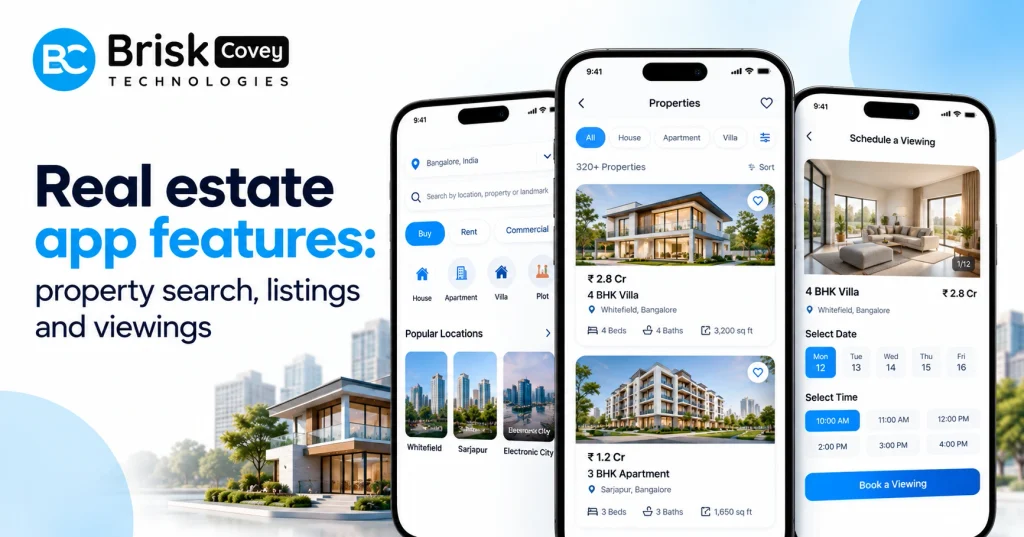
A smart real estate app development plan launches with the features each user group needs on day one, then grows with real usage.
| Feature area | For buyers and renters | For agents and brokers | For admins and owners |
| Search and listings | Map search, filters, saved searches, price alerts | Listing creation and syndication to portals | Listing approval and quality checks |
| Media | Photos, videos, floor plans, virtual tours | Easy media upload from phone | Media standards and watermarking |
| Leads and enquiries | Instant enquiry by WhatsApp, call or form | Lead inbox from every source, auto-assignment | Lead routing rules and source reports |
| Viewings | Book viewing slots online | Shared calendar, reminders, route planning | Viewing and conversion reports |
| CRM and follow-up | Updates on saved properties | Contact history, notes, tasks, follow-up reminders | Team performance dashboard |
| AI assistance | AI property search in plain language | AI lead qualification, WhatsApp replies, listing descriptions | AI usage and quality review |
| Deals and documents | Offer submission, e-signature | Deal pipeline, document checklist | Commission tracking |
| Localization | Multiple languages including Arabic, local currencies and units | Multi-language listing content | Translation workflow |
Step 2: Plan Listing Data and Integrations
Integrations decide whether a real estate app saves agents time or creates more work. Plan them by market:
| Integration | Market | What it gives you | Things to plan for |
| Property Finder and Bayut | UAE | Listing syndication and portal leads for registered agencies | Agency account access, listing format, permit numbers on ads |
| MLS via the RESO Web API, with IDX display | US | Shared listing data from local MLSs | MLS membership, data licensing and IDX display rules |
| realestate.com.au and Domain | Australia | Listing upload and enquiry leads | Agency accounts, feed formats |
| WhatsApp Business Platform | All markets | Official WhatsApp messaging and automation | Opt-in, approved message templates, 24-hour reply window |
| CRM | All markets | Contact history and pipelines | Two-way sync, avoid duplicate contacts |
| Calendars, maps and e-signature | All markets | Viewings, location data and contracts | Time zones, map usage costs, legal e-signature validity |
In the US, the Real Estate Standards Organization (RESO) sets the data standards most MLSs use, so building around the RESO Data Dictionary keeps your app compatible across many MLSs.
Two rules we follow in every real estate app development project:
- One clean property record. Merge listings from every source into a single property model, so the same apartment never appears three times.
- Sync status automatically. When a property is sold or rented, every channel updates within minutes, not days.
Step 3: Follow Compliance and Data Rules in Each Market
Real estate app development touches personal data, marketing messages and property advertising, and each market has its own rules.
| Market | Key rules to plan for | What it means for the build |
| UAE (Dubai) | Broker registration and property advertising permits from the Dubai Land Department, UAE personal data law (PDPL) | Show permit numbers on listings, store consent, keep agent licence details on profiles |
| United States | Fair Housing Act, TCPA consent rules for texts and automated calls; CAN-SPAM for email, state privacy laws such as CCPA | No discriminatory targeting or AI answers, recorded consent before automated messages, easy opt-out |
| Australia | Privacy Act, Spam Act, state rules on agent licensing and price advertising | Consent and unsubscribe for marketing, accurate price guides on listings |
| UK and EU | GDPR and UK GDPR | Lawful basis for processing, data access and deletion requests |
The technical baseline is the same everywhere: encryption in transit and at rest, role-based access so agents see only their own leads, audit logs, MFA for admin accounts, and a clear record of every consent.
This is general guidance, not legal advice. Check the rules for your market with a qualified advisor.
Step 4: Choose a Scalable Architecture and Tech Stack
If you plan to serve many brokerages, design real estate app development for multi-tenancy from the start, so each agency’s leads and listings stay fully separate.
| Layer | Our default choice | Why |
| Mobile app | React Native or Flutter | One codebase for iOS and Android, for buyers and agents |
| Web app and CRM | React with TypeScript | Fast listing pages and dense agent dashboards |
| Backend API | Python (FastAPI) or Node.js | Handles portal feeds, webhooks and AI in one stack |
| Database | PostgreSQL with row-level security per agency | Clean separation of each agency’s data |
| Search | Elasticsearch or OpenSearch with geo search | Fast map and filter search across thousands of listings |
| Media | Cloud storage with an image CDN | Quick-loading photos and videos on mobile |
| Messaging | Queues and webhooks | Reliable lead intake and WhatsApp messages at peak times |
| Hosting | AWS, Azure or GCP in the right region | Speed and data residency for each market |
Three design rules we hold to:
- Every lead gets a source and a timestamp, so you can measure response time and which portal really performs.
- Listings have one owner and one status, synced to every channel automatically.
- Images are compressed and resized on upload, because slow photos kill mobile property search.
Step 5: Add AI to Your Real Estate App Where It Pays Off
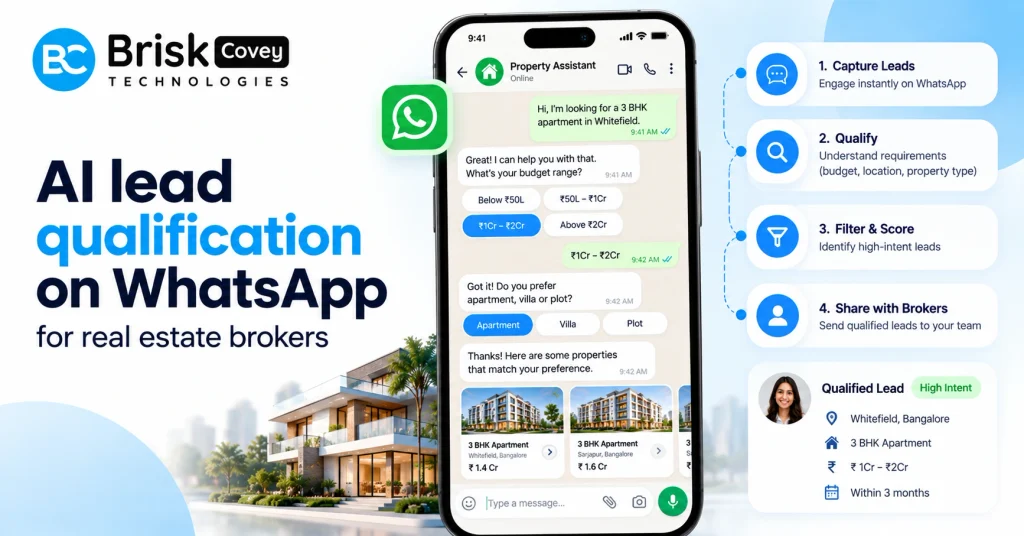
In real estate app development today, AI makes the biggest difference where agents lose the most time, answering and qualifying leads.
High-value AI features for real estate apps:
- AI lead qualification. Every new enquiry gets an instant reply that asks about budget, location, timeline and financing, then scores and routes the lead to the right agent.
- WhatsApp AI agents. Natural conversations on WhatsApp in English, Arabic and other languages, with property suggestions and viewing booking.
- AI property search. Buyers search in plain words, like “3-bedroom near a metro under 2 million with a balcony”.
- Listing description writing. AI drafts consistent, accurate descriptions from property data and photos for the agent to approve.
- Follow-up automation. AI reminds agents and sends personalized follow-ups so warm leads don’t go cold.
- Valuation and market insights. Price estimates and area trends from comparable sales, clearly labelled as estimates.
Guardrails we build into every real estate AI feature:
- AI answers only from verified listing data, no invented prices, availability or amenities.
- No discriminatory questions or steering, in line with fair housing rules.
- Messages respect consent and opt-out rules for each market.
- A human agent can take over any conversation instantly.
This is the kind of AI lead automation we build for brokers in Dubai, and it follows the same principles as our wider work on AI agent development. As an Anthropic Claude Partner, we use Claude for conversations where accurate, natural language matters.
Step 6: Follow a Real Estate App Development Process That Ships
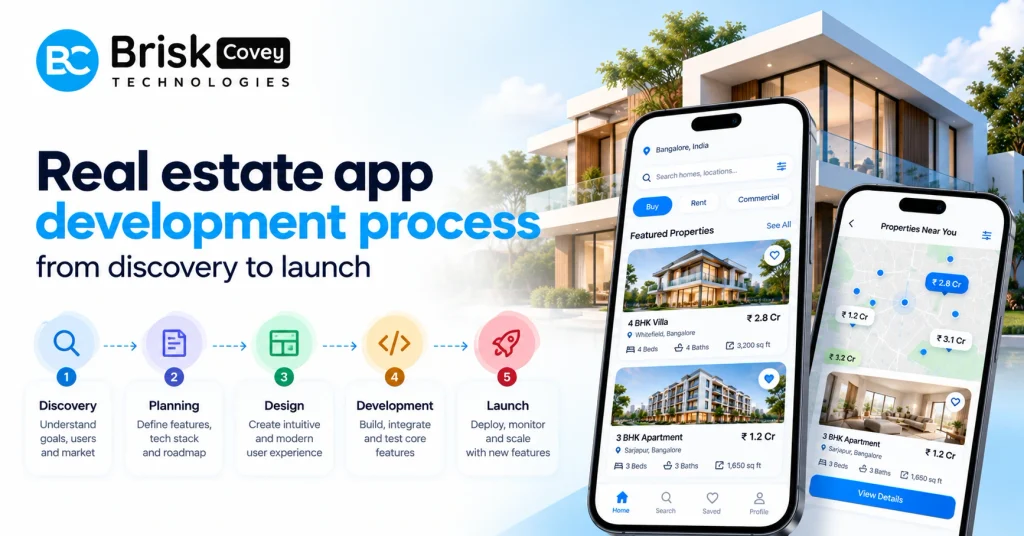
Real estate app development has one extra dependency, portal and MLS access. Start those applications early.
- Discovery (2-3 weeks). Map how leads arrive and how agents work today, choose markets and integrations, and apply for portal or MLS data access.
- UX design and prototype (2-4 weeks). Clickable prototype tested with real agents and a few buyers or renters.
- MVP build (8-12 weeks). Listings, lead inbox, CRM basics, WhatsApp integration and admin panel, in two-week sprints.
- Integrations and testing (3-5 weeks). Portal and MLS feeds, AI lead flows, load testing and a security review.
- Pilot (4 weeks). Launch with one team or office, measure response time and lead conversion, and refine.
- Scale. Add markets, languages, AI features and analytics based on real data.
In real estate app development, a focused MVP typically takes 3-4 months. A full platform with portals, CRM, WhatsApp and AI takes 5-8 months.
Real Estate App Launch Checklist
Use this checklist before any real estate app development project goes live.
- Portal and MLS access approved, with feeds tested end to end
- Listing status syncs automatically across every channel
- Permit numbers and agent licence details shown where required
- Every lead captured with source, timestamp and consent
- Instant first reply and auto-assignment rules tested
- WhatsApp templates approved and opt-out working
- AI answers only from verified listing data, with human hand-over
- Role-based access: agents see only their own leads
- Images compressed; listing pages load fast on mobile
- Privacy policy and consent screens live for each market
- Analytics set up: response time, lead-to-viewing and viewing-to-deal conversion
Frequently Asked Questions
A focused real estate MVP usually takes 3-4 months. A full platform with portal or MLS integrations, CRM, WhatsApp and AI features takes 5-8 months.
Map and filter search, detailed listings with photos and virtual tours, instant enquiries, viewing booking, saved searches and alerts, a lead inbox and CRM for agents, and in 2026, AI lead qualification and AI property search.
Yes. Registered UAE agencies can sync listings and receive leads from these portals through the integration options they provide to agencies. Plan for account access, listing formats and permit details.
In the US, an MLS shares listing data among member brokers, and IDX rules let brokers show those listings on their own websites and apps. Most MLSs now provide data through the RESO Web API.
For instant lead replies and qualification, WhatsApp conversations, plain-language property search, listing descriptions, follow-up reminders and price estimates, with answers based only on verified listing data.
For most real estate apps, cross-platform (React Native or Flutter) is faster and keeps one codebase for iOS and Android. Native makes sense only for advanced 3D, AR or heavy offline features.
You can build the same type of experience, but competing as a portal needs a large listing supply and marketing budget. Most businesses get faster results with a brokerage CRM, an agency app or AI lead automation.
With consent records for every lead, encryption, role-based access so agents only see their own leads, easy opt-out from marketing messages, and compliance with local laws like UAE PDPL, GDPR or US state privacy laws.
React Native or Flutter for mobile, React for web and CRM, Python (FastAPI) or Node.js for the backend, PostgreSQL, a geo-enabled search engine like Elasticsearch, and cloud hosting in the right region.
Briskcovey is an AI-first software studio and Anthropic Claude Partner. We build real estate apps, CRMs, portal integrations and AI lead automation, including WhatsApp agents for brokers in Dubai, for clients in the US, UK, UAE and Australia.
Build Your Real Estate App With Briskcovey
BriskCovey is an AI-first software studio in Jaipur, India, and an Anthropic Claude Partner. We offer end-to-end real estate app development, property apps, brokerage CRMs, portal and MLS integrations, and AI lead automation on WhatsApp, for clients in the US, UK, UAE and Australia. We also build travel apps and AI products with the same AI-first approach.
Whether you need AI to answer every lead in minutes, a CRM your agents will actually use, or a full property platform, we start the same way, map how leads arrive today, then remove every delay between enquiry and viewing.
Book a free 30-min real estate app discovery call