
Amadeus API integration gives a travel app access to one of the world’s largest pools of flight, hotel and travel content. For years, many startups began with Amadeus’s free Self-Service APIs. That changed in 2026, Amadeus decommissioned its Self-Service portal on 17 July 2026, and access now runs mainly through its Enterprise APIs and partner programs.
This guide explains Amadeus API integration as it works today, the access routes after the shutdown, the key APIs, authentication, the flight and hotel booking flow, production readiness and common mistakes. It’s based on how our travel app development team plans supplier integrations at Briskcovey.
Key Takeaways
- The Self-Service portal is closed. Since 17 July 2026, Self-Service API keys no longer work, new Amadeus API integration projects go through Enterprise access, partners or aggregators.
- Enterprise APIs remain fully available, but they need a commercial agreement with Amadeus and an onboarding process.
- The booking flow stays the same: search, price, book, then ticket or confirm. Never skip the pricing step.
- Ticketing needs the right setup. Issuing airline tickets requires an accredited agency or a consolidator, not just API access.
- Plan realistic timelines. An Amadeus API integration for flights and hotels typically takes 3-5 months, with commercial onboarding often taking as long as the build.
What Is the Amadeus API, and What Changed in 2026?
Amadeus is one of the largest global distribution systems (GDS). Its APIs let travel apps search and book flights, hotels, cars and other travel services, and manage bookings after they’re made.
Until 2026, Amadeus offered two developer routes. The Self-Service APIs were open REST APIs with a free test environment, popular with startups and freelancers. The Enterprise APIs were for larger travel businesses under a commercial agreement.
In 2026, Amadeus closed the Self-Service route:
| Date | What happened |
| Early 2026 | Amadeus wrote to Self-Service users announcing the portal would be decommissioned |
| June 2026 | Registration for new Self-Service users paused |
| 17 July 2026 | Self-Service portal closed and API keys disabled |
| September 2026 | Amadeus announced work with Anthropic on an AI developer toolkit for Claude Code (waitlist only at announcement) |
Amadeus has stated that its Enterprise Portal and Enterprise APIs remain fully available, and it points startups and companies to its partner and ventures programs. In practice, Amadeus API integration in 2026 means planning a commercial relationship, not just signing up for keys.
Key Amadeus APIs for Travel Apps
Exact API names, versions and formats depend on your Enterprise agreement, but most Amadeus API integration projects use the same building blocks:
| Capability | What it does |
| Flight shopping | Search fares and availability across airlines |
| Flight pricing | Confirm the final price and fare rules for a chosen itinerary |
| Flight booking | Create the booking (PNR) with traveler details |
| Booking management | Retrieve, change or cancel bookings; handle seats and extras |
| Hotel search | Find hotels and available rates for dates and guests |
| Hotel booking | Book a room with guest and payment details |
| Cars and transfers | Search and book ground transport |
| Reference data | Airports, cities, airlines and other lookups |
Many travel businesses combine Amadeus with other sources, such as airline NDC connections, hotel bed banks or activity APIs. If you’re designing the full system, see our guide to travel booking engine development.
Step 1: Choose Your Access Route
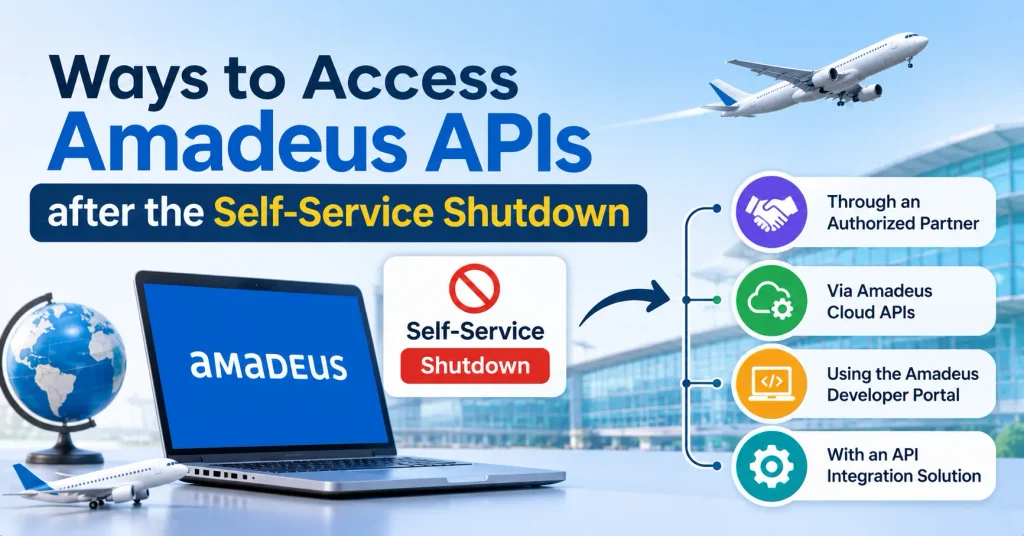
With Self-Service gone, the first decision in any Amadeus API integration is how you’ll get access:
| Route | Who it suits | What to expect |
| Amadeus Enterprise APIs | Established travel agencies, OTAs, TMCs and airlines | Commercial agreement, onboarding, test environment, certification before production |
| Amadeus partner programs | Software companies building products on top of Amadeus | Partnership terms, technical support and shared go-to-market |
| Amadeus Ventures | Funded travel startups | Startup support with Enterprise APIs behind the scenes |
| A partner or aggregator | Smaller businesses that need content quickly | Access through a company that already holds an Amadeus agreement |
| Amadeus AI toolkit for Claude Code | Developers exploring AI-driven travel builds | Announced in September 2026 with a waitlist, check availability and terms |
If you previously used the Self-Service APIs, plan a migration rather than a quick fix, Enterprise access can differ in API versions, formats, environments and commercial terms. Enterprise customers who also used Self-Service were told to contact their account managers to migrate.
A practical tip, start the commercial conversation in parallel with technical design. Onboarding, contracts and certification often take longer than writing the connector.
Step 2: Set Up Authentication
Authentication depends on which Enterprise APIs you’re given. Modern REST APIs typically use OAuth 2.0 client credentials, where your server exchanges a client ID and secret for a short-lived access token, while some traditional web services use their own security headers and sessions.
Whichever applies, follow the same rules:
- Keep credentials on the server. Never ship API keys or secrets in a mobile or web app.
- Cache tokens until they expire, and refresh them automatically instead of requesting one on every call.
- Separate test and production credentials, with different configs and secrets stores.
- Store secrets in a secrets manager, not in code or environment files committed to Git.
Steps 3-5: Search, Price and Book Flights
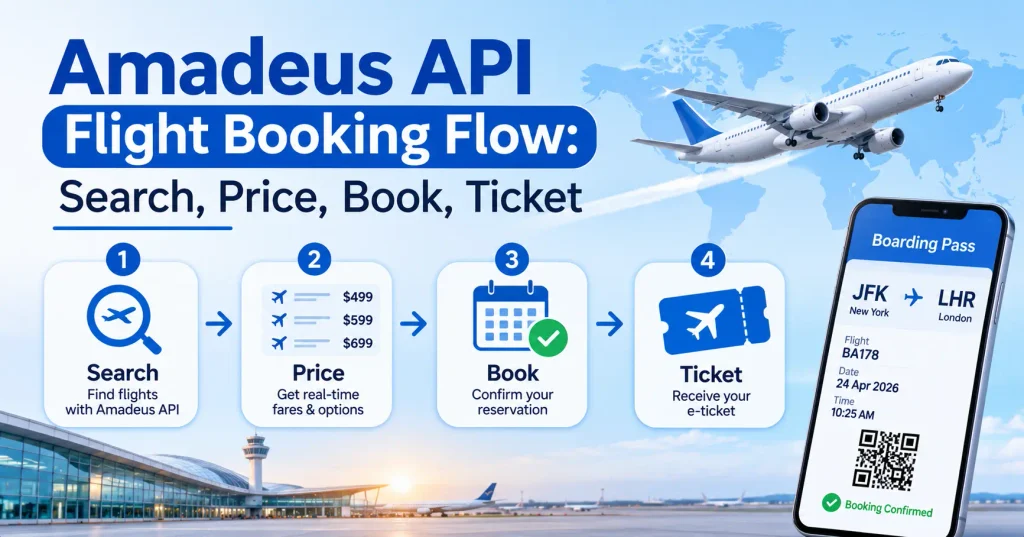
Every Amadeus API integration for flights follows the same three-stage flow.
Step 3: Search. Send origin, destination, dates, passengers and cabin class, and receive a list of flight offers with fares and availability. Show results fast, and keep the full offer data, because you’ll need it in the next step.
Step 4: Price. When the traveler picks an offer, send it back for pricing. This confirms the current fare, taxes, baggage and fare rules. Prices can change between search and checkout, so the priced amount is the one you show on the payment page.
Step 5: Book. Send the priced offer with traveler details (names exactly as on passports, contact details, and any required document data) to create the booking. Store the booking reference (PNR) and the supplier’s response.
A simplified service layer in Python shows the pattern. Endpoints, payloads and versions are placeholders, use the ones in your Enterprise API documentation.
class AmadeusFlights:
def __init__(self, client):
self.client = client # handles auth, retries, logging
def search(self, origin, destination, date, adults):
return self.client.get(“/flights/search”, params={
“origin”: origin, “destination”: destination,
“departureDate”: date, “adults”: adults,
})
def price(self, offer):
# Always re-price the chosen offer before payment
return self.client.post(“/flights/price”, json={“offer”: offer})
def book(self, priced_offer, travelers, idempotency_key):
# Idempotency key prevents duplicate bookings on retries
return self.client.post(
“/flights/book”,
json={“offer”: priced_offer, “travelers”: travelers},
headers={“Idempotency-Key”: idempotency_key},
)
Three rules for this part of an Amadeus API integration:
- Never book an unpriced offer. Always run pricing first, and compare the priced total with what the traveler saw.
- Take payment and book as one controlled transaction. If payment succeeds but booking fails, refund or alert support automatically.
- Make booking calls safe to retry so a timeout never creates two bookings.
Step 6: Search and Book Hotels
Hotel booking through an Amadeus API integration follows a similar pattern, with a few hotel-specific details:
- Find hotels by city, coordinates or hotel IDs.
- Search offers for dates, rooms and guests, with live rates and availability.
- Check the offer again before payment to confirm price, cancellation policy and board type (room only, breakfast and so on).
- Book with guest details and payment information, then store the confirmation number.
Hotel-specific points to plan for:
- Cancellation policies differ by rate. Show them clearly at checkout, and save the exact policy with each booking.
- Taxes and fees vary by city. Some are paid at the hotel, label them so totals never surprise the guest.
- Payment models differ: some rates are prepaid, others are paid at the property with a card guarantee. Handle cards through a PCI DSS-compliant gateway with tokenization.
- Map hotels once. If you also use other hotel sources, merge duplicate properties into one listing in your own database.
Step 7: Handle Errors, Limits and Caching
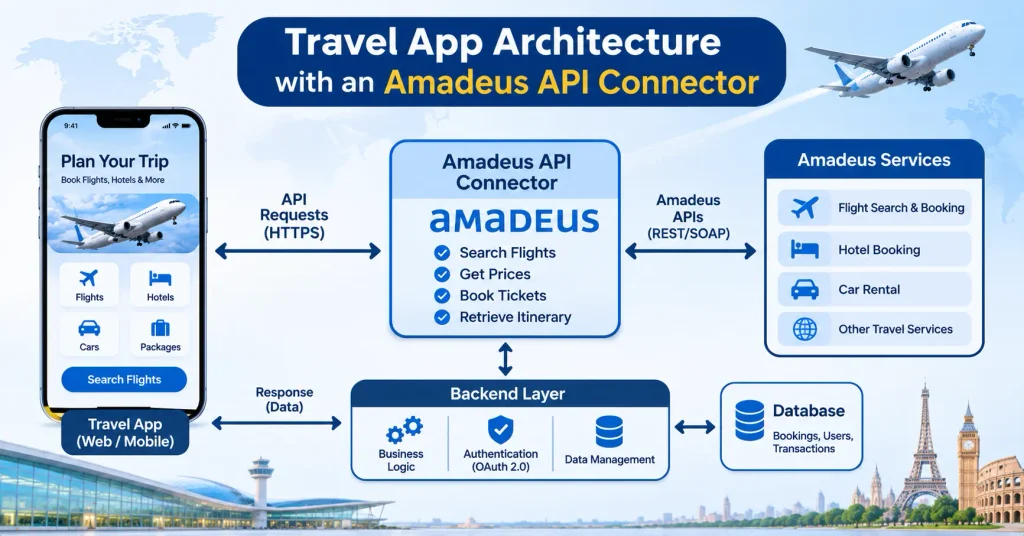
A production Amadeus API integration has to cope with busy days, slow responses and changing prices:
- Respect rate and transaction limits in your agreement, with queues and exponential backoff.
- Set timeouts so one slow call never freezes your search page.
- Cache search results briefly for speed, but never cache prices through to payment. Always re-price before checkout.
- Cache reference data such as airports and airlines for much longer.
- Log every request and response (without card data) with a correlation ID, so support can trace any booking.
- Map supplier errors to clear messages, such as “This fare is no longer available. Here are similar options.”
- Watch your look-to-book ratio. Searches and bookings can carry different commercial terms, so avoid unnecessary searches.
Step 8: Go to Production and Ticketing
Moving an Amadeus API integration to production usually involves more than switching a URL:
- Complete testing in the test environment, including failures, cancellations and refunds.
- Pass Amadeus certification or review, where your agreement requires it.
- Set up ticketing. Creating a flight booking doesn’t issue a ticket. Ticketing requires an IATA-accredited agency or a consolidator who issues tickets on your behalf. Arrange this early.
- Confirm payments and compliance: a PCI DSS compliant gateway, privacy rules for each market (GDPR, CCPA, UAE PDPL), and any travel licensing your business model needs.
- Launch gradually, monitor every booking, and keep a manual fallback for urgent cases.
Airlines are also moving more offers to IATA’s NDC standard, so ask about NDC content in your Amadeus agreement if flights are central to your business.
Common Amadeus API Integration Mistakes
- Planning a new project around the old Self-Service APIs, which no longer work
- Starting the build before the commercial agreement, then waiting months for access
- Booking without re-pricing, so travelers are charged a different amount than they saw
- Assuming a booking means a ticket, without arranging ticketing
- Putting API credentials in a mobile or web app
- Making too many unnecessary searches, which hurts performance and can add costs
- Tying the whole app to one supplier’s data format instead of building your own internal model
Amadeus API Integration Checklist
Use this checklist before any Amadeus API integration goes live.
- Access route agreed (Enterprise, partner, Ventures or aggregator)
- Test environment and credentials set up; secrets stored on the server
- Search, price and book flow working, with re-pricing before every payment
- Idempotent booking calls; no duplicate bookings or charges in tests
- Payment-success / booking-failure handled with automatic refunds or alerts
- Ticketing arranged through an accredited agency or consolidator
- Hotel cancellation policies, taxes and fees shown clearly
- Rate limits, timeouts and caching rules in place
- Logging with correlation IDs, and no card data in logs
- Certification or review completed where required
- Internal data model independent of any one supplier
Frequently Asked Questions
Amadeus API integration is connecting a travel app, website or booking engine to Amadeus’s APIs to search, price, book and manage flights, hotels and other travel services.
No. Amadeus decommissioned its Self-Service portal on 17 July 2026, and Self-Service API keys were disabled. Amadeus says its Enterprise Portal and Enterprise APIs remain fully available.
Mainly through an Amadeus Enterprise agreement, Amadeus partner programs, Amadeus Ventures for startups, or a partner company that already holds Amadeus access. Amadeus also announced an AI developer toolkit with Anthropic, which opened with a waitlist.
If you’re an Enterprise customer, contact your Amadeus account manager. Otherwise, choose a new access route, then review differences in API versions, formats and environments before rebuilding your connector.
Creating a booking is not the same as issuing a ticket. Ticketing requires an IATA-accredited agency or a consolidator that issues tickets on your behalf.
A flight and hotel Amadeus API integration typically takes 3-5 months, including commercial onboarding, development, testing and certification.
Yes. Depending on your needs, travel apps also use other GDS providers such as Sabre and Travelport, airline NDC connections, flight and hotel aggregators, and hotel bed banks.
Briskcovey is an AI-first software studio and Anthropic Claude Partner. We build booking engines, supplier integrations and AI booking assistants for travel businesses in the US, UK, UAE and Australia, and we help plan the right access route for your business.
Work With Briskcovey
BriskCovey is an AI-first software studio in Jaipur, India, and an Anthropic Claude Partner. We handle end-to-end Amadeus API integration and wider supplier integration for travel businesses: choosing the right access route after the Self-Service shutdown, building search, pricing and booking flows, and connecting them to booking engines, apps and AI booking assistants. For the bigger picture, read our Travel App Development in 2026 guide and our guide to AI agent development.
Whether you’re migrating from the old Self-Service APIs or starting a new travel product, we start the same way, confirm your access route, then design a supplier-independent booking flow around it.
Book a free 30-minute Amadeus API integration consultation