
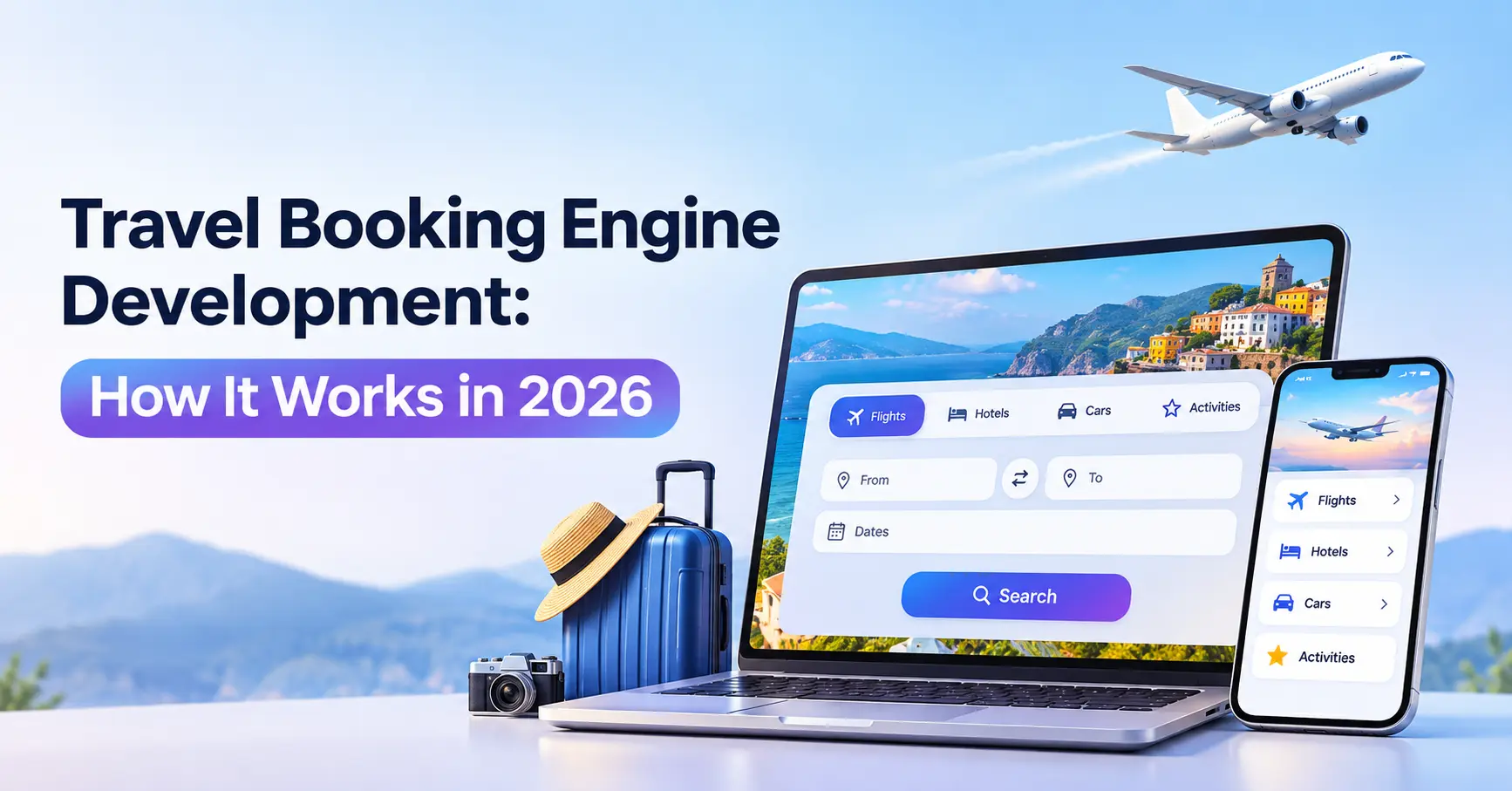
Travel booking engine development is the core of every travel business that sells online. Whether you run a tour company, a travel agency, a hotel group or an online travel startup, the booking engine is what turns a search into a confirmed, paid booking.
This guide explains travel booking engine development in simple words, how a booking engine works, the modules it needs, supplier integrations, pricing rules, security, and whether to build or buy. It’s the same approach our travel app development team uses at Briskcovey.
Key Takeaways
- A booking engine is a workflow, not a search box. It searches, checks availability, re-prices, holds, books, takes payment and confirms, every time.
- Supplier integrations shape everything. GDS, NDC, bed banks and activity APIs decide your inventory, speed and margins.
- The price shown must be the price charged. Cache for speed, but always re-check price and availability before payment.
- Pricing rules are your business logic. Markups, commissions and B2B agent rules belong in an admin panel, not in code.
- Plan realistic timelines. In travel booking engine development, a single-supplier engine typically takes 3-4 months, a multi-supplier B2B and B2C engine takes 6-9 months.
What Is a Travel Booking Engine?
A travel booking engine is software that lets customers or agents search travel inventory, see live prices and availability, and book and pay in one flow. It connects to suppliers (airlines, hotels, tour operators) on one side and to your website, app or agent portal on the other.
Travel booking engine development usually falls into one of these types:
| Type of booking engine | Who books | What it sells | Main challenge |
| B2C booking engine | Travelers on your website or app | Flights, hotels, tours or packages | Conversion and price accuracy |
| B2B travel booking engine | Travel agents and sub-agents | Wholesale inventory with markups | Agent rules, credit limits and commissions |
| Hotel booking engine (direct) | Guests on a hotel’s own site | Rooms and add-ons | Sync with PMS and channel manager |
| Flight booking engine | Travelers or agents | Airline seats and extras | GDS and NDC complexity, ticketing rules |
| Tours and activities engine | Travelers | Time-slot experiences | Capacity, time slots and vouchers |
| Multi-supplier engine | Both | Everything above, combined | Content mapping and de-duplication |
Most travel businesses don’t need every type. Start with the one that matches how you sell today, then expand.
How a Travel Booking Engine Works
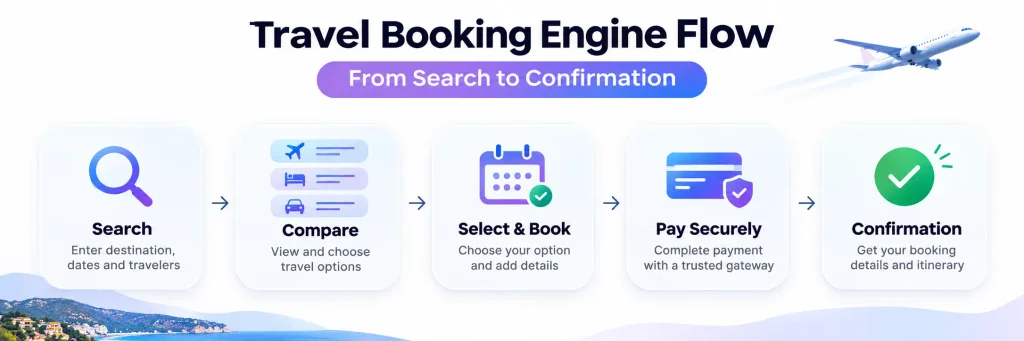
Every booking passes through the same seven steps. Good travel booking engine development makes each one fast and reliable:
- Search. The engine queries suppliers in parallel and returns fast, cached results.
- Availability check. When the traveler selects an option, the engine confirms it’s still available.
- Price verification. It re-prices live, so the total on the payment page is the total charged.
- Hold. Where suppliers allow, the seat or room is held while the traveler pays.
- Payment. The traveler pays through a secure, PCI-compliant gateway.
- Booking and ticketing. The engine confirms the booking with the supplier and issues e-tickets or vouchers.
- After booking. Confirmations, changes, cancellations, refunds and reminders.
If payment succeeds but the supplier booking fails, the engine must catch it, retry safely, and refund or alert support automatically. Handling these edge cases is what separates a reliable booking engine from a fragile one.
Core Modules of a Travel Booking Engine
| Module | What it does |
| Search and results | Multi-supplier search, filters, sorting and maps |
| Supplier connectors | One connector per supplier, translating their APIs into your data model |
| Content mapping | Merges the same hotel or tour from different suppliers into one listing |
| Pricing and rules engine | Applies markups, discounts, commissions and taxes |
| Booking manager | Runs the booking steps, holds, confirmations and failures |
| Payments | Checkout, refunds, multi-currency and fraud checks |
| Customer and agent accounts | Profiles, saved travelers, booking history, agent hierarchies |
| Admin panel | Suppliers, rules, content, bookings, reports and support tools |
| Notifications | Email, SMS, WhatsApp and push messages at every step |
| Reporting | Sales, margins, supplier performance and conversion |
Supplier Integrations: GDS, NDC, Bed Banks and More
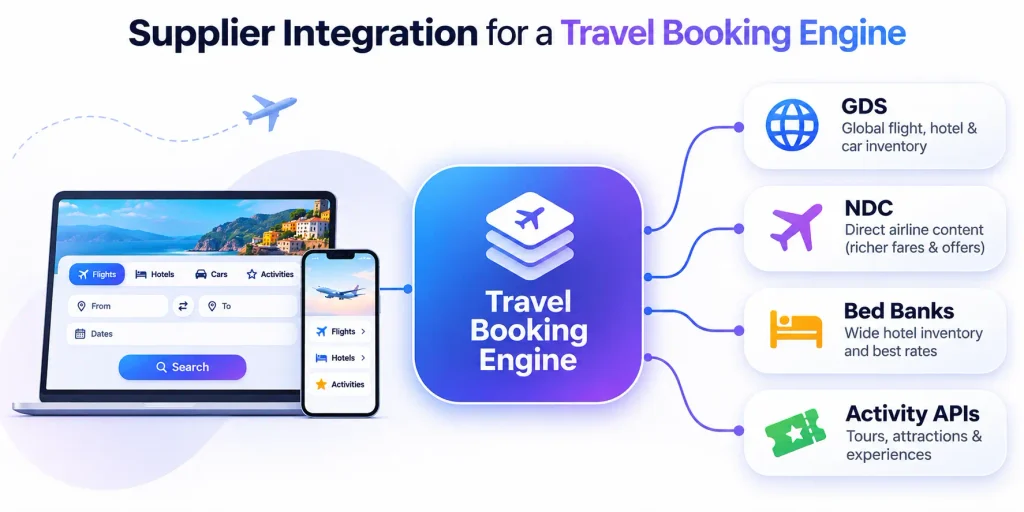
In travel booking engine development, suppliers decide what you can sell. Most engines combine several sources:
| Source | What it gives you | Examples | Plan for |
| GDS | Flights, plus hotels and cars, through one connection | Amadeus, Sabre, Travelport | Certification, fees, ticketing rules |
| Airline NDC APIs | Richer airline offers, bundles and extras | NDC-enabled airlines and aggregators | A different flow per airline |
| Bed banks and wholesalers | Large hotel inventory at net rates | Hotelbeds, WebBeds | Cancellation policies and rate rules |
| Channel managers and PMS | Direct hotel rates and availability | Hotel channel management systems | Room-type mapping |
| Activity APIs | Tours, tickets and experiences | Activity marketplaces | Time slots and capacity |
| Your own inventory | Your packages, tours and contracted rates | Admin-managed products | Allotments and blackout dates |
Teams often start in a sandbox with a self-service API such as Amadeus for Developers, then sign production agreements. Because airlines keep moving offers to IATA’s NDC standard, new flight booking engines should be ready for both GDS and NDC content. Start supplier applications early: production access and certification often take longer than the code.
Pricing, Markups and Multi-Currency
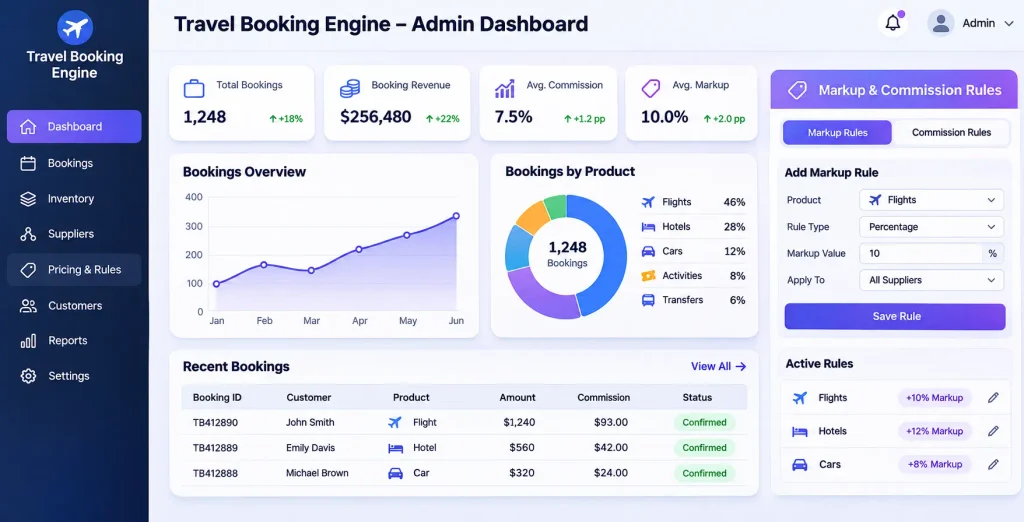
The pricing engine is where a booking engine makes money. Build it as configurable rules in the admin panel, not hard-coded logic:
- Markups and discounts by supplier, destination, product type, season or customer group.
- B2B agent rules: agent-specific markups, commission levels, credit limits and deposit options.
- Taxes and fees shown clearly, so the total never surprises the traveler.
- Multi-currency pricing with stored exchange rates and the currency of every price saved alongside it.
- Promo codes and packages that combine flights, hotels and activities into one price.
Speed, Caching and Reliability
Travelers leave slow search pages, and suppliers limit how often you can call them. Travel booking engine development has to balance both:
- Search in parallel across suppliers, and show results as they arrive instead of waiting for the slowest one.
- Cache smartly with short, sensible lifetimes for prices and availability, and re-check live before payment.
- Respect rate limits with queues and backoff, so you don’t get blocked by a supplier on a busy day.
- Set timeouts and fallbacks, so one slow supplier never freezes the whole search.
- Plan for peak seasons with auto-scaling cloud hosting and load testing before holidays.
Payments and Security
A booking engine handles payment cards, passport details and itineraries, so security is built in from the start:
- Never store raw card data. Use a gateway that meets PCI DSS with tokenization, plus 3-D Secure checks.
- Make every booking request idempotent, so a retry after a timeout never causes a double booking or double charge.
- Encrypt personal data in transit and at rest, and follow privacy laws such as GDPR, CCPA or UAE PDPL.
- Protect agent accounts with role-based access and MFA for admins.
- Log every supplier call and booking step, which makes support, refunds and disputes far easier.
AI Features in a Modern Booking Engine
In 2026, travel booking engine development increasingly includes AI that makes searching and selling easier:
- Conversational search: travelers describe the trip in plain words, and the engine turns it into a structured search.
- AI trip planning: day-by-day itineraries built from real, bookable inventory.
- WhatsApp and chat booking assistants that answer questions, send quotes and hand complex cases to an agent.
- Smart ranking and personalization based on traveler preferences and past bookings.
- Disruption help: rebooking suggestions when flights are delayed or cancelled.
The golden rule, AI never invents a price or a seat. Every option it shows is checked live through the booking engine first. We follow the same guardrails described in our guide to AI agent development.
Build vs Buy: White-Label or Custom Booking Engine?
| White-label booking engine | Custom travel booking engine development | |
| Time to launch | Weeks | Months |
| Upfront effort | Low | Higher |
| Flexibility | Limited to the vendor’s features | Built around your business model |
| Supplier choice | The vendor’s suppliers | Any supplier you sign with |
| Branding and UX | Template-based | Fully your own |
| Ongoing fees | Monthly or per-booking fees | Hosting and maintenance only |
| Best for | Testing a market quickly | Growing businesses with unique products, B2B rules or AI plans |
A common path, start white-label to validate demand, then invest in custom travel booking engine development once you know what makes your business different.
Travel Booking Engine Development Process
- Discovery (2-3 weeks). Define what you sell, to whom (B2C, B2B or both), which suppliers and payment gateways you need, and your pricing rules. Start supplier applications now.
- Design (3-4 weeks). Search, results, checkout and agent portal designs, tested with real travelers or agents.
- Core build (8-12 weeks). Booking manager, first supplier connectors, pricing engine, payments and admin panel.
- More suppliers and certification (3-6 weeks). Additional connectors, content mapping and supplier certification.
- Testing (2-4 weeks). Sandbox bookings, failure scenarios, load tests and a security review.
- Soft launch and scale. Launch to a small audience, monitor every booking, then add suppliers, markets and AI features.
In travel booking engine development, a single-supplier engine typically takes 3-4 months. A multi-supplier B2B and B2C engine takes 6-9 months, mostly because of supplier certification.
For the bigger picture, from choosing your type of travel app to launch, read our Travel App Development in 2026 guide.
Travel booking engine launch checklist
- Supplier production access and certification completed
- Live price and availability re-check before every payment
- Payment-success / booking-failure cases handled with automatic refunds or alerts
- Idempotent booking requests; no double bookings or charges in tests
- Markup, commission and agent rules configurable in the admin panel
- PCI DSS compliant gateway with tokenization and 3-D Secure
- Timeouts, rate limits and supplier fallbacks tested
- Load test passed for peak season traffic
- Confirmations, cancellations and refund flows tested end to end
- Reports for sales, margins and supplier performance live
Frequently Asked Questions
A travel booking engine is software that lets travelers or agents search travel inventory, see live prices and availability, and book and pay in one flow, connected to suppliers like airlines, hotels and tour operators.
A single-supplier booking engine usually takes 3-4 months. A multi-supplier engine for both B2B and B2C sales takes 6-9 months, mostly because of supplier certification.
A B2C engine sells directly to travelers. A B2B engine serves travel agents, with agent accounts, markups, commissions, credit limits and sub-agent hierarchies.
GDS systems like Amadeus, Sabre and Travelport, airline NDC APIs, hotel bed banks such as Hotelbeds and WebBeds, channel managers, activity APIs and your own inventory.
They cache search results for speed but re-check price and availability live with the supplier before payment, so the price shown is the price charged.
White-label is faster for testing a market. Custom travel booking engine development is better when you need your own suppliers, B2B rules, branding or AI features.
Through a PCI DSS compliant gateway with tokenization and 3-D Secure, idempotent booking requests to prevent double charges, and encryption of personal data.
Yes. Common AI features include conversational search, AI trip planning, chat and WhatsApp booking assistants, personalization and disruption handling, with every price verified live.
Briskcovey is an AI-first software studio and Anthropic Claude Partner. We build booking engines, supplier integrations and AI booking assistants for travel businesses in the US, UK, UAE and Australia.
Build Your Booking Engine With Briskcovey
Briskcovey is an AI-first software studio in Jaipur, India, and an Anthropic Claude Partner. We offer end-to-end travel booking engine development: B2C and B2B engines, GDS, NDC and bed bank integrations, pricing and markup engines, secure payments and AI booking assistants, for travel businesses in the US, UK, UAE and Australia.
Whether you’re replacing a white-label engine, adding new suppliers, or building from scratch, we start the same way, map how you sell today, then design the booking flow around it.
Book a free 30-minute booking engine discovery call